
Hello, Amiga
This is the smallest complete Clorraine program. It prints one templated line and exits with status 0.
Source
module demo.Hello;

import { println } from std.io;

func main(): i32 {
    let who: str = "Amiga";
    println($"Hello, {who}, from Clorraine!");
    return 0;
}
The file is examples/hello/hello.clo.
Run it
On the host profile:
clorraine run examples/hello/hello.cloOutput:
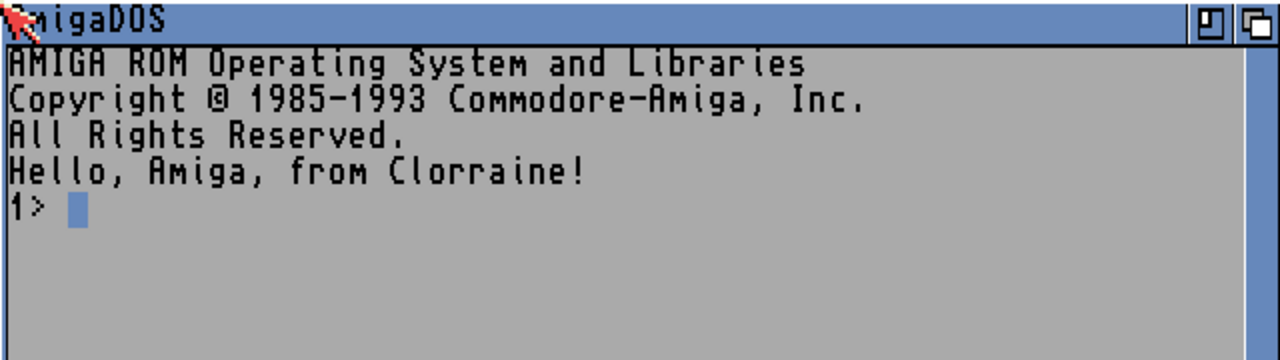
Hello, Amiga, from Clorraine!On AmigaOS through vamos, from a checkout with the SDK:
make run FILE=examples/hello/hello.clo PROFILE=hosted-amigaOn an A1200 with Kickstart 3.1 in FS-UAE:
make run FILE=examples/hello/hello.clo \
  PROFILE=hosted-amiga EMULATOR=1
On an A500 with Kickstart 1.3:
make run FILE=examples/hello/hello.clo \
  PROFILE=hosted-amiga-13 EMULATOR=1
The emulator paths need a licensed Kickstart ROM. The vamos path needs no ROM.
What Kickstart 3.1 sees
The screenshot below is from a real A1200 / Kickstart 3.1 boot. The A500 / Kickstart 1.3 smoke gate still checks the same output line:
The generated C
The compiler emits one C99 translation unit. This is a trimmed excerpt of the main body; line directives, temporary names, and the platform shim are omitted for readability:
static i32 cl_demo_Hello_main(void)
{
    ClStr who = {0};
    ClString __cl_owned0 = 0;
    ClString __cl_tmp0 = 0;
    i32 __cl_ret = 0;

    who = cl_str("Amiga");
    __cl_tmp0 = cl_text_str((who).ptr, (who).len);
    __cl_owned0 = cl_string_concat(
        (ClStrPart[]){
            cl_str_part_bytes((const u8 *)"Hello, ", 7u),
            cl_str_part_owned(__cl_tmp0),
            cl_str_part_bytes((const u8 *)", from Clorraine!", 17u)
        }, 3u);
    cl_std_io_println(cl_string_view(__cl_owned0));

    __cl_ret = 0;
    if (__cl_owned0) { FreeString(__cl_owned0); }
    return __cl_ret;
}
The owned string is released once, on the exit path. The call to cl_std_io_println is a direct C call. There is no interpreter and no ownership runtime in the generated program.
To read the whole file:
clorraine emit examples/hello/hello.clo -p host -o build/hello.cWhat it demonstrates
| Feature | In this program |
|---|---|
| Modules and imports | module demo.Hello; and import { println } from std.io; |
| A borrowed string view | let who: str = "Amiga"; |
| String interpolation | $"Hello, {who}, from Clorraine!" |
| An owned temporary | The interpolated string, released at scope exit |
| The entry point | func main(): i32 |
Next: the string parser shows loops, enums, and switch in a larger program.